Showing posts with label detection devices. Show all posts

Monday, October 31, 2011

EARN MONEY: DARPA Offers $50,000 for Ideas to Re-assemble Shredded Documents


The sometimes enigmatic government agency that has been in the vanguard of historic computer network development, including creation of the Internet, is taking a more popular approach to a more prosaic problem --  how to re-assemble shredded documents.
photo courtesy
gsnmagazine.com
The Defense Advanced Research Projects Agency (DARPA) said it is offering computer scientists, “puzzle enthusiasts and anyone else who likes solving complex problems” a $50,000 prize for the best ideas in putting shredded documents back together again.
The agency said its “Shredder Challenge” is aimed at solving a nagging problem in warzones where soldiers find remnants of destroyed documents that could possibly contain important battlefield intelligence. Piecing those documents back together could be a valuable source of information that could save soldiers’ lives. Additionally, the agency said, understanding how shredded documents could be re-assembled by clever day-to-day citizens and scientists could also help the U.S. national security community, it said.  Read more

Thursday, July 14, 2011

RADIOLOGICAL DETECTION > Major League Baseball All Star game got radiological threat detection team


Chase Field
As Major League Baseball’s best players took the field at the All Star Game on July 12, the National Nuclear Security Administration (NNSA) fielded its own team of experts at the event to support overall preventative radiological/nuclear detection (PRND) security measures.
The deployment to Chase Field in Phoenix, AZ was routine for NNSA. The agency deploys teams more than 100 times a year, mainly within the U.S., it said, adding that most are radiological search deployments that are based on intelligence, support of law enforcement, or planned events like the MLB’s All-Star game, presidential inaugurations or political conventions.
The agency said it provided personnel and equipment resources over a six-day period to enhance security measures at the game.
The PRND operations at Chase Field included support personnel from NNSA’s Radiological Assistance Program (RAP), the FBI Hazardous Materials Response Team (HMRT), Maricopa County Sheriff’s Office, and the Phoenix Fire and Police Departments, according to NNSA.  Read more

Tuesday, July 12, 2011

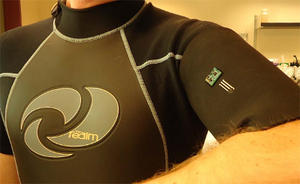
EXPLOSIVE DETECTION > Sensors printed on wetsuits detect explosives, other hazards

Published 12 July 2011
UC San Diego researcher has successfully printed thick-film electrochemical sensors directly on flexible wetsuit material, paving the way for nano devices to detect underwater explosives or ocean contamination; UCSD has a full U.S. patent pending on the technology, and has begun talks on licensing the system to a Fortune 500 company

Flexible sensors printed on neoprene wetsuit sleeve // Source: calit2.net
Breakthroughs in nanoengineering often involve building new materials or tiny circuits. A professor at the University of California, San Diego, however, is proving that he can make materials and circuits so flexible that they can be pulled, pushed, and contorted — even under water — and still keep functioning properly.
Joseph Wang has successfully printed thick-film electrochemical sensors directly on flexible wetsuit material, paving the way for nano devices to detect underwater explosives or ocean contamination.
“We have a long-term interest in on-body electrochemical monitoring for medical and security applications,” said Wang, a professor in the Department of NanoEngineering in UC San Diego’s Jacobs School of Engineering. “In the past three years we’ve been working on flexible, printable sensors, and the capabilities of our group made it possible to extend these systems for use underwater.”
Wang notes that some members of his team — including electrical-engineering graduate student Joshua Windmiller — are surfers. Given the group’s continued funding from the U.S. Navy, and its location in La Jolla, it was a logical leap to see if it would be possible to print sensors on neoprene, the synthetic-rubber fabric typically used in wetsuits for divers and surfers    Read more

Thursday, July 7, 2011

BIODEFENSE > Nano detector spots deadly anthrax

Published 7 July 2011

Methods in Molecular Biology #504: Biosensors and Biodetectors, Vol 2: Electrochemical and Mechanical Detectors, Lateral Flow and Ligands for Biosensors: Methods and Protocols Cover
image coutesy of powells.com
An automatic and portable detector that takes just fifteen minutes to analyze a sample suspected of contamination with anthrax is being developed by researchers in the United States. The technology amplifies any anthrax DNA present in the sample and can reveal the presence of just forty microscopic cells of the deadly bacteria Bacillus anthracis.
B. anthracis, commonly known as anthrax, is a potentially lethal microbe that might be used intentionally to infect victims through contamination of food and water supplies, aerosolized particles, or even dried powders, such as those used in bioterrorist attacks in the United States in fall 2001. Detection is crucial to preventing widespread fatalities in the event of an anthrax attack.

The complexity of the microbe’s biology have so far made it difficult to build a portable system that can be employed quickly in the field. That said, there are several systems available that use PCR to amplify a particular component of the genetic material present in anthrax and then to flag this amplified signal. These systems are fast and sensitive but do not integrate sample preparation and so are not as convenient as a single detector unit would be.  Full article


DETECTION > TSA could begin searching for explosives hidden inside you

photo courtesy of HSNW

[2 mins read] 

TSA could begin searching for explosives hidden inside you 

Published 7 July 2011
Government intelligence officials are now warning airlines that terrorists could be using surgically implanted explosives to bypass security measures; there is no information regarding a specific plot or threat, but airlines could begin to implement additional screening procedures as the current body scanners cannot effectively detect bombs hidden inside an individual; last year, al Qaeda operatives in Iraq implanted two dogs with explosives, but the dogs died before they could be loaded onto a U.S.-bound plane.

According to the Los Angeles Times, U.S. officials have received new information that suggest terrorists may be seriously considering surgically implanting explosive devices to circumvent existing screening procedures.
In response, Nicholas Kimball, a spokesman for the Transportation Security Administration (TSA), said airline passengers flying into the United States will likely face additional screening measures.
These measures are designed to be unpredictable, so passengers should not expect to see the same activity at every international airport,” Kimball said. “Measures may include interaction with passengers, in addition to the use of other screening methods such as pat-downs and the use of enhanced tools and technologies.”
Current body scanners cannot detect explosive materials hidden in body cavities or below the skin, so airport screeners will rely on explosive trace detection swabs.
In 2009, in a failed suicide bomb attack aimed at assassinating Prince Mohammed Bin Nayef, the head of Saudi Arabia’s counterterrorism operations, an al Qaeda operative hid a pound of high explosives and a detonator in his rectum.  Read more

Wednesday, July 6, 2011

CBRNE > Enzyme Might Hold Key to Countering Nerve Agents

G-Type Nerve Agents
Military Chemical Agent Sign for "G agents"

Enzyme Might Hold Key to Countering Nerve Agents


Drugs produced from a natural enzyme could one day be used to protect people exposed to lethal nerve agents, the U.S. National Institutes of Health said on Friday (see GSN, April 28).
The health agency is providing funding for work by Israel's Weizmann Institute of Science to develop medications that could disassemble organophosphate chemicals used in "G-type" nerve agents such as sarin and soman.
"Drugs based on [this] approach would be a valuable addition to our nation’s ability to mount an effective medical response in the event of a chemical emergency," David Jett, head contact for the NIH Countermeasures Against Chemical Threats program, said in a press release.
Sarin was notably used by the Japanese Aum Shinrikyo cult in two attacks that killed 20 people in 1994 and 1995 (see GSN, March 8).
The U.S. chemical arsenal, which is due to be fully eliminated in about 10 years, also includes sarin (seeGSN, July 5). For complete article 

TECHNOLOGY > New Android facial biometric app available

New Android facial biometric app available
Published 5 July 2011

Biometrics & Authentication Sector report from Homeland Security NewsWire
A new app for Android smartphones allows users to secure their phones using facial biometrics; the Visidon Applock application, which is currently available for free, locks a user’s apps until their identity is verified using facial biometrics

A new app for Android smartphones allows users to secure their phones using facial biometrics.

The Visidon Applock application, which is currently available for free,locks a user’s apps until their identity is verified using facial biometrics.

The app requires phones or tablets to have the Android 2.3 operating system or higher as well as a front-facing camera. Visidon is currently working on a version that can be used for phones without front-facing cameras.

In the event that the facial recognition does not function properly or results in a false negative, users have the ability to punch in a password to override the system.

The TalkAndroid newswire says that the app is something users should keep an eye on as it will continue to be refined.  For more

Friday, June 24, 2011

Security > Border Patrol uses wireless cameras originally intended to photograph wildlife


Tree-mounted
BuckEye Cam
The Spokane, WA, sector of the U.S. Border Patrol plans to purchase about 70 long-range wireless camera systems that were originally designed to photograph deer and other animals in the wild, but are now being used in a variety of security applications and as part of the war on terror.
The cameras will be supplied byAthens Technical Specialists, Inc., of Athens, OH, which markets individual cameras – as well as an integrated collection of as many as 30 cameras known as the BuckEye Cam CellBase – under the nameBuckEye Cam.

Friday, June 17, 2011

Tornado Sirens > Proved Beneficial in Rural Communities

Tornado[Sirens may not save property, but they sure as heck SAVE LIVES!]


On April 27, 2011, widespread damage was reported in Guntersville, AL, with trees down and some residents trapped in vehicles or homes. Trees and power lines blocked roadways as tornadoes ranging from EF-0 to EF-4 struck Marshall County. Five fatalities were recorded. According to Anita McBurnett, Marshall County’s Director of Emergency Management, the picture could have been grimmer in several rural communities had warning systems not been in place.  Read more

Wednesday, May 18, 2011

Anthrax > Attack Threat Persists, DHS Says

anthrax Anthrax
image coutesy of: diseasepicture.com

Anthrax Attack Threat Persists, DHS Says

"The threat of an attack using a biological agent is real and requires that we remain vigilant. A wide-area attack using aerosolized Bacillus anthracis, the bacteria that causes anthrax, is one of the most serious mass casualty biological threats facing the U.S.," DHS chief medical officer Alexander Garza said during a May 12 hearing of the House Homeland Security emergency preparedness subcommittee.
Five people died and more were made sick by the 2001 anthrax mailings. The FBI years later identified Army scientist Bruce Ivins as the perpetrator, but the microbiologist committed suicide before charges were filed (see GSN, April 21).
"An anthrax attack could potentially encompass hundreds of square miles, expose hundreds of thousands of people, and cause illness, death, fear, societal disruption and economic damage," Garza said. "If untreated, the disease is nearly 100 percent fatal, which means that those exposed must receive life-saving [medical countermeasures] as soon as possible."  Full article

Saturday, May 14, 2011

L.L.Bean > Emergency Weather Radio with Tone Alert

Stay informed during storms, power outages or trips to remote locations

Emergency Weather Radio
Stay informed and be prepared during a power outage or an emergency with this portable FR-360 radio, made for L.L.Bean by Eton. Updated with a digital readout and an easier-to-use handcrank, the internal NIMH battery can also charge on solar power. Receives AM, FM and all seven NOAA weather stations (US and Canada only) to help you dial into news and follow storm conditions. NOAA Weather Alert feature can be set to automatically turn the radio on when an alert is broadcast. Features an earphone jack, a built-in LED with emergency flash, and electronic and cellphone charging ports. Can also run on three AAA batteries, not included. Imported.
Dimensions  6½"H x 6¼"W x 2"D.
Weight  1 lb. 5 oz.
Batteries  Three AAA (optional; not included).

OBL ID > How Osama bin Laden was identified


The complete article is below
Osama bin LadenCross Match's SEEK II may have identified bin Laden

SEEK II from Florida-based Cross Match is a 4-pound computer that captures photographs, complete fingerprints, and iris scans; its memory holds the images and biometrics of up to 60,000 people; unconfirmed reports suggest that the Navy SEALs who killed bin Laden used a SEEK II to identify him; there are about 5,000 SEEK II devices in the field, being used by the U.S. military, border patrol, and law enforcement agencies, and also by other militaries

The SEEK II combines three technologies in one unit // Source: crossmatch.com
It appears that the Navy SEALs who killed Osama bin Laden used a device from Palm Beach Gardens, Florida-based Cross Match to identify the al Qaeda’s founder, allowing President Obama to declare in his speech to the nation last week that bin laden was dead.
The Palm Beach Post reports that Cross Match representatives would not confirm whether their product was used in the identification of bin Laden, partly because they are not sure. Still, the Post says that company representatives “offer tantalizing hints, such as that the Department of Defense is one of their biggest clients and that their mobile device is the only one approved by the FBI to take rolled fingerprints, which provide more data and better matches than flat prints.”
The paper quotes Michael Oehler, vice president of mobile biometrics, to say that it appears that a Cross Match product was used to identify bin Laden “really is a good feeling, I must say. We have a very strong sense of patriotism in the company.”
The device likely used to identify bin Laden is the SEEK II — a 4-pound computer that captures photographs, complete fingerprints, and iris scans. Its memory holds the images and biometrics of “60,000 of your favorite bad guys,” Oehler said. With 3G technology or a satellite connection, the SEEK also can link to databases all over the world. This means that SEEK can identify a match within seconds – and helpful feature when the identification has to be doe under fire.
Oehler would not specify to the Post which data points the SEEK registers, but he said the technology generally measures things such as space between the eyes or the nostrils. It looks for features that do not degrade (measuring skin, which sags with age or can be transformed by plastic surgery, would not be useful).
Ohler noted that although an iris scan is 100 times more accurate than fingerprints, it is unlikely the military used the iris scan feature on bin Laden because that would require a previous iris scan to make a match. Moreover, even if bin Laden’s iris had been in the system, the SEALs would have had to move quickly to compare it with the real thing because an iris is “valid” for only five to ten minutes after death.
The company notes that there are fewer than 5,000 SEEKs currently in the field. The device is used by the U.S. military and other armies, and also by border patrol and other law enforcement agencies.   to see full article by HSNW

Monday, May 9, 2011

Terrorism Update > 29 DC schools receive envelopes with suspicious powder

FBI details DC school letters investigation.  
- by Mark Rockwell

Duke Ellington High School in DC


Federal investigators continue to log a mounting number of suspicious letters containing a white powder mailed to dozens of Washington DC, schools.

Saturday, April 9, 2011

2 unthinkable detection devices>Trained honeybees & Spray on explosive detector...no joke, read more!


Home
Article's courtesy of HSNW

[Innovative thinking...beyond belief. 

-SDFBlogger]


New device uses sniffer bees to detect explosives

Published 6 April 2011
Cassette containing six trained sniffer bees
Source: wordpress.com
The unassuming honeybees have a hidden talent -- an even keener sense of smell than anyone first expected -- which could make them one of the U.K.'s most ruthless and worst-feared weapons against terrorism; researchers developed a portable handheld sensor that holds thirty-six trained bees gently restrained in six cassettes inside the device; each is taught to recognize a particular odor and associate that smell with a food reward; the researchers have already trained their honeybees to detect a wide variety of explosive compounds and mixtures, including Semtex, C4, PE4, TNT, DMNB, gunpowder, and hydrogen peroxide.  

Image courtesy of scritchandscratch.com
Spray-on explosives detector
Published 5 April 2011
A chemist at Oklahoma State University has developed a spray-on material that detects explosives made from peroxides and renders them harmless; the material is a type of ink that contains nanoparticles of a compound of molybdenum. The ink changes color, from dark blue to pale yellow or clear, in the presence of explosives.For more>http://homelandsecuritynewswire.com/spray-explosives-detector