Showing posts with label mitigation. Show all posts

Monday, July 25, 2011

FREE COURSE > Risk Communication Strategies for Public Health Preparedness

Johns Hopkins Bloomberg School of Public HealthDescription


Risk communication is an exchange of information about the likelihood and consequences of adverse events. In an emergency, effective risk communication is vital because it helps the public respond to the crisis, reduces the likelihood of rumors and misinformation and demonstrates good leadership. This training product will help you be more effective as a communicator and member of a crisis response team. After reviewing basic ideas about risk communication, you will learn to develop crisis communication plans and deliver public health messages by working with the media.

TOPIC 1: RISK COMMUNICATION STRATEGIES FOR PUBLIC HEALTH PREPAREDNESS

  • Part 1: Background on Risk Communication
  • Part 2: What is Risk Communications?
  • Part 3: Working with the Media
  • Part 4: Communications Plans and Strategies
  • Part 5: Crisis Communications
  • Part 6: Implications and Action Steps
Useful Risk Communication-related Web sites:

Friday, July 22, 2011

DISASTER COMMUNICATION: Bringing First Responder Communications Into the 21st Century

Posted: 7/21/11 11:44 AM ET
photo courtesy apfn.org

New Yorkers know better than anyone the constant threat that our country faces. As we've seen time and again, New York continues to be the number one target for terrorists around the world who want to harm Americans.

That's why, as the Senator from New York, I am extremely concerned that we not forget the lessons of 9/11.

One important lesson we learned on that horrific day was how crucial it is that our first responders can communicate in real time between agencies in a time of emergency. We have the best firefighters, police officers, emergency medical technicians and public safety professionals in the world, yet currently they communicate on different frequencies and with different systems -- creating barriers to providing a coordinated and efficient response during a crisis.

DISASTER COMMUNICATION: Call for Public Safety Wireless Network

Published: July 20, 2011 at 5:44 PM
By ROBERT SPOERL, MEDILL NEWS SERVICE, Written for UP
WASHINGTON, July 20 (UPI) -- A bipartisan coalition of U.S. politicians urged that the auction of wireless spectrum be used to, in part, fund a public safety wireless network for first responders, which has been stalled since the days following the Sept. 11 terrorist attacks.
U.S. Sen. Charles Schumer, D. N.Y., said Wednesday at the U.S. Capitol that the plan would save lives and make emergency response more efficient without costing taxpayers money.
"To get this kind of help for our first responders without it costing the taxpayers a dime is a great accomplishment," Schumer said.
"The 9/11 Commission Report," released in 2004, called for a public safety communication network. First responders had difficulty communicating in the chaos after the attacks, chiefly because various departments were on different radios and networks.
Some telecommunications companies have spectrum they don't use. Part of the bill would establish a means to persuade broadcasters and companies to return spectrum to the government. The Federal Communications Commission would have an "incentive auction" selling extra spectrum. Proceeds from that auction would go toward creating the public safety network.

Monday, July 18, 2011

ACTIVE SHOOTER TIPS: Your Response to an Active Shooter UCLA Document

[A great 2 page desktop procedural guide for Active Shooter incidents, which are becoming more and more common. This document can be printed, folded and put under our phones at work, somewhat like our bomb threat guides.]
An Active Shooter is a situation where one or more suspects participate in a random or systematic shooting spree, and demonstrating intent to continuously harm others. The overriding objective appears to be that of inflicting serious bodily injury/death rather than other criminal conduct. These situations are dynamic and evolve rapidly, demanding immediate deployment of law enforcement resources to stop the shooting and mitigate harm to innocent victims.

Sunday, July 17, 2011

FREE COURSE: FAST Foundations (Disaster Behavioral Health First Aid Specialist Training)

Program Aim: The FAST Foundations program is intended to provide training in the foundational knowledge necessary to effectively deliver Psychological First Aid (PFA) to children, adolescents, adults, and families in the immediate aftermath of disaster.

Program Goals: 
• Define and describe Psychological First Aid. • List the basic objectives of Psychological First Aid. • Identify guidelines for delivering Psychological First Aid to adults, children, older adults and persons with disabilities. • Identify guidelines for delivering Psychological First Aid to adults, children, older adults and persons with disabilities. • Identify things that the Psychological First Aid provider should know and do when preparing to deliver Psychological First Aid. • Recognize survivors who are at increased risk for adverse psychosocial outcomes. 
• Identify the 8 Core Actions of Psychological First Aid and the related goal(s) and key tasks.

FREE COURSE > BIOTERRORISK

[This is a really good course for any and all who have any degree of disaster response/management]

Who is responsible for protecting the public's health against a
bioterrorist threat?
Since the events of 9/11/2001 and the Anthrax outbreak in the U.S., it is now recognized that bioterrorist risk may come to attention and require "first response" from physicians, nurses, laboratory personnel, communicable disease surveillance specialists, public health officers, and environmental hazmat teams.
Bioterrorisk is a case-based, mini-course in hazard recognition, interagency communication, risk assessment, and risk communication for the public health workforce.


At the end of this course, you will be able to:

1.Identify your role in responding to a bioterrorist event
2.Recognize circumstances that may indicate bioterrorism
3.Establish intra- and interagency communication
4.Follow an appropriate protocol for responding to a bioterrorist event
5.Communicate with the public regarding risk
6.Assemble a list of resources available to assist in a bioterrorist event

Thursday, July 14, 2011

ICE > Readies Disaster Response Teams for Hurricane Season


RRT deploys
U.S. Immigration and Customs Enforcement is readying response teams that would provide support to ICE and DHS facilities if hurricanes strike this summer and fall.
ICE’s Rapid Response Teams (RRTs) deploy during natural and manmade disasters, emergency situations when other federal, local or state agencies request ICE assistance.

Teams have already been deployed this summer in the Midwestern U.S. to help with recovery from flooding along the Missouri River, according to ICE. Teams from Denver, Boston, and Newark, NJ, and Boston were recently deployed to Dakota Dunes, SD to assist the Federal Emergency Management Agency (FEMA) with law enforcement support. The team members are scheduled to provide assistance through mid-August 2011, said the agency.  Read more

Wednesday, July 13, 2011

FREE COURSE > NEW FEMA IS-111.a - Livestock in Disasters

IS-111.a - Livestock in Disasters  (access course)

Course Date

New as of  12 July, 2011

Course Description

This course combines the knowledge of livestock producers and emergency managers to present a unified approach to mitigate the impact of disasters on animal agriculture.

Course Objectives

The objectives of this course are to learn understand issues that arise when disasters affect livestock, determine a farm's susceptibility to hazards, and identify actions to reduce economic losses and human and animal suffering in disasters.

Primary Audience

Emergency management officials and livestock owners.

CEUs

0.4

Course Length

3.5 hours

FBI > Establishes Graduate Degree in WMD Studies

image courtesy of:  topsecretwriters.com
Wednesday, July 13, 2011
The FBI has established a graduate program at a Pennsylvania university for its agents to study counterterrorism and weapons of mass destruction, thePittsburgh Tribune-Review reported on Tuesday (see GSN, Feb. 17).
The multiple year program at Indiana University of Pennsylvania is currently only open to FBI personnel. Other departments ultimately might be able to have students study for the master of science in strategic studies in weapons of mass destruction.
"It's not going to be open enrollment (or) traditional students," university criminologist Dennis Giever said.
"You worry about whether you might be teaching the wrong person this stuff," he said.
The degree program includes studies of of radiological "dirty bombs," strikes on the energy infrastructure and food-based bioterrorism.
The FBI three years ago began talks with the university on establishing the WMD studies program, according to bureau Weapons of Mass Destruction Directorate countermeasures and preparedness chief Doug Purdue.
While several universities were approached, only Indiana University of Pennsylvania had existing programs specializing in anti-WMD efforts, Purdue said.
Thirty-four FBI agents have to date taken specialized WMD classes through the university. The bureau and other government branches anticipate spending $300,000 annually to send 15 to 20 personnel to enroll in the graduate program.
Some analysts who believe there is a low risk of a WMD strike on the United States have said such efforts are an unproductive use of government funds.
"It seemed ridiculous to some people," Federation of American Scientists Terrorism Analysis Project Director Charles Blair said. "But even if the risk is really low, it's still good to have some people looking at it in an academic sense" (Pittsburgh Tribune-Review/Pennlive.com, July 12).

Tuesday, July 12, 2011

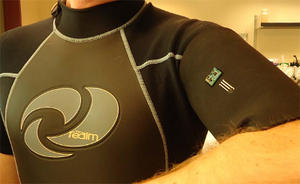
EXPLOSIVE DETECTION > Sensors printed on wetsuits detect explosives, other hazards

Published 12 July 2011
UC San Diego researcher has successfully printed thick-film electrochemical sensors directly on flexible wetsuit material, paving the way for nano devices to detect underwater explosives or ocean contamination; UCSD has a full U.S. patent pending on the technology, and has begun talks on licensing the system to a Fortune 500 company

Flexible sensors printed on neoprene wetsuit sleeve // Source: calit2.net
Breakthroughs in nanoengineering often involve building new materials or tiny circuits. A professor at the University of California, San Diego, however, is proving that he can make materials and circuits so flexible that they can be pulled, pushed, and contorted — even under water — and still keep functioning properly.
Joseph Wang has successfully printed thick-film electrochemical sensors directly on flexible wetsuit material, paving the way for nano devices to detect underwater explosives or ocean contamination.
“We have a long-term interest in on-body electrochemical monitoring for medical and security applications,” said Wang, a professor in the Department of NanoEngineering in UC San Diego’s Jacobs School of Engineering. “In the past three years we’ve been working on flexible, printable sensors, and the capabilities of our group made it possible to extend these systems for use underwater.”
Wang notes that some members of his team — including electrical-engineering graduate student Joshua Windmiller — are surfers. Given the group’s continued funding from the U.S. Navy, and its location in La Jolla, it was a logical leap to see if it would be possible to print sensors on neoprene, the synthetic-rubber fabric typically used in wetsuits for divers and surfers    Read more

EARTHQUAKE DETECTION > Volunteers help California build quake sensor network

Image courtesy of USGS.gov

Published 12 July 2011
Thousands of residents across California are helping the U.S Geological Survey (USGS) build a dense network of seismic sensors across the state; as part of the Quake Catcher Network, Californians are being asked to place 6,000 seismic sensors in their homes to help geologists study earthquakes


Thousands of residents across California are helping the U.S Geological Survey (USGS)build a dense network of seismic sensors across the state.
As part of the Quake Catcher Network, Californians are being asked to place 6,000 seismic sensors in their homes to help geologists study earthquakes. Last weekend the program was introduced in the San Francisco Bay Area with the help of University of California, Berkeley and Stanford University.
“With thousands of volunteers hosting our seismic sensors, forming dense networks in these regions, we’ll be able to get data on a level of detail and with a degree of accuracy that we could only dream about before” said Jesse Lawrence, assistant professor of geophysics at Stanford University, where the project is based.
The sensors can be plugged into a computer’s USB port and need to be firmly secured to the ground to prevent false readings. Using special software and an internet connection, data is transmitted from the device back to Stanford University, where the information is being collected.
Elizabeth Cochran, a USGS research geophysicist,explained that the sensors will allow geologists to track ground movements after an earthquake from more locations to enable a denser record of seismic data.  Read more

Thursday, July 7, 2011

FREE TRAINING > Anhydrous Ammonia Training

This is the best training I have ever seen on anhydrous ammonia.  Please pass along to all your emergency responder buddies and who ever else might benefit from this great training!  
Photo courtesy of:  http://transcaer.com
Below is the list of contents.  Go to course page
  1. Introduction
  2. How To Use This Training Package
  3. Student Handbook
  4. Properties
  5. Transports
  6. Railcars
  7. Emergency Response
  8. Additional Materials
  9. Sponsors & Partners
  10. Conclusion

WEBINAR 19JUL2011 > Preparing For the Unexpected: The Trigger Events for Systemic Failure

Preparing For the Unexpected: The Trigger Events for Systemic Failure

Join us for a Webinar on July 19

This topic outlines the situation, complications and solutions to help leaders ensure the continuity of business operations in the face of unprecedented risks. The hypothesis is that a convergence of many long wave cycles is increasing the probability and impact of large scale disasters such as the incident in Japan. Surviving and thriving amidst these threats requires an enterprise resiliency plan that encompasses all internal functions, suppliers, and enterprise eco-system touch points. Are you prepared?

NUCLEAR > Nuclear Safety Journal Launched


Published 7 July 2011
Inderscience Publishers

Three Mile Island, Chernobyl, Fukushima: for the third time in twenty-five years a nuclear power plant suffered a serious accident, precipitating a global review of the way to govern nuclear safety and security; a publisher of scientific journal is launching a new journal -- International Journal of Nuclear Safety and Security (IJNSS) -- which will offer a forum for the serious discussion of nuclear power plants' safety
pThree Mile Island, Chernobyl, Fukushima: for the third time in twenty-five years a nuclear power plant suffered a serious accident, precipitating a global review of the way to govern nuclear safety and security.
The 11 March Fukushima accident was especially poignant because it came during — and may well put an end to — what was correctly termed a Nuclear Renaissance: as worries about climate change and the volatility of oil prices grew, interest in nuclear power generation was rekindled.
InderScience Publishers is launching a new journal — teInternational Journal of Nuclear Safety and Security (IJNSS) — which aims to address the growing interest in, and concern about, nuclear safety.
The publisher says that the international community must learn from these accidents in order to improve international co-operation, both in terms of crisis management and prevention of risks. IJNSS will provide an opportunity to exchange information on the implications of safe and secure operation of nuclear power plants and approaches taken by countries worldwide.   Full article
Among the topics which will be covered by the new journal:
  • Strategic, managerial, organizational issues; total quality management (TQM) and environmental management
  • Macroeconomics, nuclear economics and business
  • Technological advances, issues, innovation, hazards; role of information and communication technologies (ICTs)
  • Analysis/assessment methodologies, performance measurement
  • Governance, policy strategy, assessment, review
  • National/international environmental protection policy; ecosystem research
  • Ecological/environmental impacts; risk assessment/legal aspects of pollution
  • Waste disposal strategies; clean technologies
  • Energy security and risk assessment; policy, standards and regulations
  • Critical infrastructures design, protection, management
  • Risk assessment, control, characterization, perception, communications, models
  • Integrated risk assessment and safety management
  • Nuclear systems management, transport, resource development, power quality
  • Public policy, regulations, governance and nuclear use; public attitudes
  • Knowledge based policies and education; knowledge transfer