Showing posts with label technology. Show all posts

Thursday, September 22, 2011

SEARCH and RESCUE TECHNOLOGY: Saving Victims Trapped Under Concrete

http://www.raytheon.com/capabilities/products/cirt/
New tool allow first responders to reach those trapped beneath concrete more quickly; the tool generates a high-energy jolt to create a contained hole in the concrete; a series of these holes allows the creation of an area large enough to deliver vital supplies such as food, water, and medicine to victims before first responders are able to get victims to safety.


When the twin towers collapsed on 11 September 2001, one of the challenges that first responders faced was cutting through concrete to get to victims trapped under debris — a common problem when tragedy strikes.
Breaching reinforced concrete has long been a race against time when relying on drills, saws, and jackhammers – a race which those trapped under slabs of concrete, and those who were trying to rescue them, often lost.
DHS’s Science and Technology Directorate (S&T) has developed a new tool to help fire departments and search-and-rescue teams better deal with such challenges in the wake of natural and man-made disasters.
In 2007 S&T led the development of the Controlled Impact Rescue Tool (CIRT), designed to cut through concrete with speed and precision. The CIRT uses blank ammunition cartridges to drive a piston that generates a high-energy jolt to create a contained hole in the concrete. A series of these holes allows the creation of an area large enough to deliver vital supplies such as food, water, and medicine to victims before first responders are able to get victims to safety.  Read more.

Wednesday, August 10, 2011

INVISIBLE CLOAK PERFECTED: Undergraduate Student Overcomes Major Hurdle to Invisibility Cloak

[Sorry, no image or photo...I mean really now, how do you photograph something that just isn't there...]

Published 10 August 2011
An undergraduate student has overcome a major hurdle in the development of invisibility cloaks by adding an optical device into their design which not only remains invisible itself, but also has the ability to slow down light; the innovation open up the possibility for a potential invisibility cloak wearer to move around amongst ever-changing backgrounds of a variety of colors
An undergraduate student has overcome a major hurdle in the development of invisibility cloaks by adding an optical device into their design which not only remains invisible itself, but also has the ability to slow down light.
The optical device, known as an “invisible sphere,” would slow down all of the light that approaches a potential cloak, meaning that the light rays would not need to be accelerated around the cloaked objects at great speeds — a requirement that has limited invisibility cloaks to work only in a specified region of the visible spectrum.
This new research, published 9 August in the Institute of Physics and German Physical Society’s New Journal of Physics, could open up the possibility for a potential invisibility cloak wearer to move around amongst ever-changing backgrounds of a variety of colors.
Institute of Physics release reports that Hungarian-born Janos Perczel, who is studying Logic, Philosophy of Science, and Physics at the University of St Andrews and who works under the guidance of Professor Ulf Leonhardt, acknowledged the huge potential of the invisible sphere and was able to fine-tune it so that it was a suitable background for cloaking.

Monday, August 8, 2011

TECHNOLOGY: Beachball-like Observation UAV Developed

Published 8 August 2011
A beach ball-size drone can fly down narrow alleys, hover on the spot, take off vertically, bounce along the ground like a soccer ball -- all the time transmitting live images from a video camera; it can travel above traffic or spy on a target through a window -- and can also be used in search and rescue in disaster zones, where it could fly through buildings and even up and down stairways

Fumiyuki Sato with his beachball UAV // Source: xatakaciencia.com
A Japanese researcher working for Japan’s Ministry of Defense has developed a spherical observation UAV that can fly down narrow alleys, hover on the spot, take off vertically, bounce along the ground like a soccer ball – all the time transmitting live images from a video camera.
The drone – or Spherical Air Vehicle (SAF) — is the size of a beach ball, and it is controlled by an operator with a remote control. It is powered by a propeller protected by a spherical shield with large openings for airflow, allowing it to hit a wall or a tumble to the ground without damaging the propeller. Tech.blorge reports that the device’s designer is continuing to work to improve it. The designer says that in the future the SAF could be used as a formidable pursuit vehicle that can travel above traffic or spy on a target through a window.
Its inventor says it could also help in such as search and rescue in disaster zones, where it could fly through buildings and even up and down stairways.
The developer, Fumiyuki Sato, a research engineer at the Technical Research and Development Institute Ministry of Defense, said that “This is the world’s first spherical air vehicle.”  Read more

Monday, July 18, 2011

TECHNOLOGY: "Amplified" Nanotubes for Efficient, Loss-free Grid

The current U.S. copper-based grid leaks electricity at an estimated 5 percent per 100 miles of transmission; Rice University researchers have achieved a breakthrough in the development of a cable that will make an efficient electric grid of the future possible; the armchair quantum wire (AQW) will be a weave of metallic nanotubes that can carry electricity with negligible loss over long distances

Rice University scientists have achieved a breakthrough in the development of a cable that will make an efficient electric grid of the future possible.
Armchair quantum wire (AQW) will be a weave of metallic nanotubes that can carry electricity with negligible loss over long distances. It will be an ideal replacement for the U.S. copper-based grid, which leaks electricity at an estimated 5 percent per 100 miles of transmission, said Rice chemist Andrew R. Barron, author of a paper about the latest step forward published online by the American Chemical Society journal Nano Letters.
A Rice University release reports that a prime technical hurdle in the development of this “miracle cable,” Barron said, is the manufacture of massive amounts of metallic single-walled carbon nanotubes, dubbed armchairs for their unique shape. Armchairs are best for carrying current, but can not yet be made alone. They grow in batches with other kinds of nanotubes and have to be separated out, which is a difficult process given that a human hair is 50,000 times larger than a single nanotube.  Read more

Saturday, July 16, 2011

CYBER TERRORISM > Threat Grows More Destructive, Lynn Says

American Forces Press Service

Cyber Threat Grows More Destructive, Lynn Says

By Karen Parrish
American Forces Press Service
WASHINGTON, July 15, 2011 – The cyber threat the United States faces is increasing in severity and is accessible to a wide range of enemies, Deputy Defense Secretary William J. Lynn III said in a television interview broadcast last night.By Karen Parrish
American Forces Press Service
“Most of what we see today is exploitation -- that's theft, stealing secrets, either commercial or military,” Lynn told Ray Suarez on “PBS Newshour.” “[But] we know the tools exist to destroy things, to destroy physical property, to destroy networks, to destroy data, maybe even take human lives.”
Lynn said nation-states currently are the sole possessors of sophisticated cyber tools, but the capability will spread over time.
“It's going to migrate to rogue states, and it's going to migrate to, eventually, terrorist groups,” he said. “At some point, you're going to see a marriage of capability and
intent, and that is what we should truly worry about.”
DOD is working both to defend its own networks and support the Department of Homeland Security’s mission to protect systems important to national security, Lynn said.
Pentagon officials yesterday released the Defense Department’s first strategy aimed at countering the cyber threat. The strategy document charts the increase of Internet usage since 2000, when there were 360 global users, to 2010’s 2 billion. DOD alone has 15,000 networks and more than 7 million computing devices.
“In the first instance, we're protecting those military capabilities,” Lynn said. “But we need to go further. Working through the Department of Homeland Security, we need to think about how we might use better defensive capabilities to protect … the power grid, the transportation network, the financial sector.”
DOD is not committing to protecting the entire Internet, Lynn said.
“We're talking with our allies about how we have a collective
defense,” he said. “We're working with them to share technologies, to share understandings of the threat, so that we have a collective defense approach to this important problem.”
Most cyber attacks happening now are malicious activity, some are criminal, and some reach the level of espionage, Lynn said.
“We have seen a few cases … where it goes above that and degrades networks themselves,” he said, noting the 2007 attack on Estonia and the 2008 cyber assault on the republic of Georgia.
Defending the cyber domain requires a new way of thinking, Lynn said.
“It's different than land, sea, air and space,” he noted. “It's largely privately owned. It crosses borders. It doesn't respect sovereignty. And the speed at which it moves, keystrokes on one side of the globe can have an impact on the other in the blink of an eye.”
U.S. Cyber Command is responsible for organizing DOD’s efforts in the cyber domain, the deputy secretary said.
“They're out hiring people, both in uniform and as civilians, with … [the] cyber skills that we need,” he added. “They're different kinds of skills than we might need with conventional soldiers, but they're equally important.”
DOD doesn’t monitor or scan commercial networks in the United States, Lynn said.
“We're trying to work with the appropriate agencies, the FBI, with law enforcement, the Department of Homeland Security, for protection of critical infrastructure to provide capabilities … that the Defense Department has that might be used for those critical missions,” he said. “But we don't have the primary role.”

Tuesday, July 12, 2011

NUCLEAR > Two antinuclear activists become pro-nuclear technology communicators

By Rod Adams
Two British environmental writers who were bitterly opposed to nuclear energy development just a few years ago decided to do some homework. Their questioning attitude and fact seeking minds have led them to the inescapable conclusion that most of the arguments against nuclear energy repeatedly offered by the opposition have been pure fabrications. George Monbiot and Mark Lynas both bring assets to the battle for hearts and minds in the energy source debate that are hard to match – they are recent converts to a pro-nuclear technology position with deep credentials in the environmental community. In addition, they are professional communicators with stories to tell.


Last Friday, Lynas’s publisher launched his new book titled The God Species: How the Planet Can Survive the Age of Humans. Within hours, customers who tried to access the book via Amazon.co.uk received a message stating that the book was not currently being offered because it was under review/investigation. Since Lynas had taken some aggressively controversial positions in the book, several of his fans offered conspiratorial explanations for Amazon’s decision to pull the book off of the virtual shelves.


After a flurry of Twitter tweets and blog posts, the issue was resolved and access to the book was restored. Apparently someone thought that the book would be a hardcover and complained to Amazon when they received it in a trade paperback format. As someone in the entertainment business once said – no publicity is bad publicity as long as they spell your name right. I bought the book for my Kindle partially based on the attention that the implications of possible censorship generated in the social media world.  For more

CONFERENCE > Biometric Consortium Conference and Technology Expo

Biometric Consortium Conference 2011 logo
Tuesday 27 September 2011:
Department of Defense:
  • Co-moderator - Mr. John Boyd, Director, Defense Biometrics & Forensics, Assistant Secretary of Defense, Research and Engineering
  • Co-moderator - Dr. Thomas Killion, Director, Biometrics Identity Management Agency (BIMA)
System Integrator Industry Panel:
  • Moderator - Ms. Barbara Humpton, Vice President, Booz Allen Hamilton
IEEE Biometrics, Identity & Security (BIdS) Research Showcase:
  • Co-moderator - Dr. Stephanie Schuckers, Associate Professor, Department of Electrical Engineering and Computer Engineering, Clarkson University
  • Co-moderator - Dr. Michael Schuckers, Associate Professor of Statistics and Director of the Quantitative Resource Center, St. Lawrence University
Standards:
  • Moderator - Mr. Fernando Podio, Co-Chair, Biometric Consortium, Computer Security Division (CSD), National Institute of Standards and Technology Information Technology Laboratory (NIST/ITL)
International:
  • Moderator - Dr. Raul Sanchez-Reillo, Associate Professor, Manager of the University Group for Identification Technologies, Carlos III University of Madrid Spain
Wednesday 28 September 2011:
National Institute of Standards and Technology:
  • Moderator - Mr. Michael D. Garris, Image Group Leader, Information Access Division (IAD), National Institute of Standards and Technology / Information Technology Laboratory (NIST/ITL)
Department of Homeland Security:
  • Moderator - Ms. Patricia Wolfhope, Biometrics Transition Program Manager, Department of Homeland Security (DHS)
Special Rapid DNA Session:
  • Moderator - Dr. Thomas Callaghan, Senior Biometric Scientist, Federal Bureau of Investigation (FBI) Laboratory
Face Technology:
  • Moderator - Dr. Richard Vorder Bruegge, Senior Photographic Technologist, Federal Bureau of Investigation (FBI) Science and Technology Branch
Iris Technology:
  • Moderator - Dr. James R. Matey, Research Professor, United States Naval Academy
Thursday 29 September 2011:
Keynote Speaker:
  • Dr. Ernest Reith, Associate Executive Assistant Director, Federal Bureau of Investigation (FBI), Science and Technology Branch
Department of Justice:
  • Moderator - Mr. James Loudermilk, Senior Level Technologist, Federal Bureau of Investigation (FBI) Science and Technology Branch
Department of Transportation:
  • Moderator - Mr. William Baron, Program Manager, US DOT Volpe Center
Biometrics as a Service:
  • Moderator - Cathy Tilton, Vice President, Standards & Technology, Daon

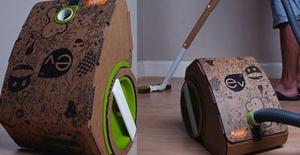
TECHNOLOGY > World's first cardboard vacuum cleaner unveiled

A U.K. vacuum cleaner manufacturer will market a high performance vacuum cleaner constructed out of recycled and recyclable materials; the device was designed by an industrial design student; the corrugated cardboard panels that form the body of the machine are easily replaced if damaged and cost just a tenth of the price of an equivalent plastic panel

Vax's ev, world's first cardboard vacuum cleaner // Source: facenews.ua
Vax, a U.K. floor-care products maker, is championing young British design talent by producing the world’s first cardboard vacuum cleaner, designed by Loughborough University student, Jake Tyler.
The company says the Vax ev is a high performance vacuum cleaner constructed out of recycled and recyclable materials that reduce the burden on landfill. The corrugated cardboard panels that form the body of the Vax ev are easily replaced if damaged and cost just a tenth of the price of an equivalent plastic panel. A Vax release reports that these panels are multi-purpose too, beginning their life as part of the retail box the vacuum cleaner is sold in. Once the cardboard parts are separated from the box, they “pop” into place around the motor housing, without any need for glue. They have a flame retardant coating and are fully customizable — with just a few felt tip the vacuum cleaner can be turned into a unique work of art!  Read more

CYBERSECURITY > Critical vulnerability found in Apple iPhones and iPads


Published 12 July 2011
Apple is scrambling to develop a fix for a software vulnerability that leaves its iPhone, iPad, and iPod Touch devices susceptible to hackers; according to Germany's Federal Office for Information Security, which discovered the critical software vulnerability, hackers can steal confidential data from the devices without the user even suspecting it by exploiting a flaw in the program that allows users to "jail-break" their devices and run non-Apple software
Apple is scrambling to develop a fix for a software vulnerability that leaves its iPhone, iPad, and iPod Touch devices susceptible to hackers.
According to Germany’s Federal Office for Information Security, which discovered the critical software vulnerability, hackers can steal confidential data from the devices without the user even suspecting it. By exploiting a flaw in the program that allows users to “jail-break” their devices and run non-Apple software, hackers have already begun stealing sensitive data much to the alarm of security analysts.
Installing the software to jail-break Apple devices carries security risks, but many users choose to do it anyways so that they have the freedom to install applications or software that have not been pre-approved by Apple.
Charlie Miller, a prominent hacker of Apple products, said that it probably took many months to develop a program that allows users to circumvent Apple’s restrictions, but hackers would only need a few days to tamper with the product for malicious purposes.
A site has already developed a software fix for the program, but downloading it would require users to defy Apple and jailbreak their device.
So far Apple has yet to develop a solution. Bethan Lloyd, a spokeswoman for Apple, said the company is “aware of this reported issue and developing a fix.” There has been no word on when the patch will become available.  Read more