Showing posts with label transportation. Show all posts

Tuesday, July 12, 2011

EXPLOSIVE DETECTION > Sensors printed on wetsuits detect explosives, other hazards

Published 12 July 2011
UC San Diego researcher has successfully printed thick-film electrochemical sensors directly on flexible wetsuit material, paving the way for nano devices to detect underwater explosives or ocean contamination; UCSD has a full U.S. patent pending on the technology, and has begun talks on licensing the system to a Fortune 500 company
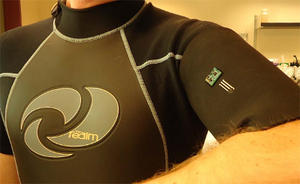
Flexible sensors printed on neoprene wetsuit sleeve // Source: calit2.net
Breakthroughs in nanoengineering often involve building new materials or tiny circuits. A professor at the University of California, San Diego, however, is proving that he can make materials and circuits so flexible that they can be pulled, pushed, and contorted — even under water — and still keep functioning properly.
Joseph Wang has successfully printed thick-film electrochemical sensors directly on flexible wetsuit material, paving the way for nano devices to detect underwater explosives or ocean contamination.
“We have a long-term interest in on-body electrochemical monitoring for medical and security applications,” said Wang, a professor in the Department of NanoEngineering in UC San Diego’s Jacobs School of Engineering. “In the past three years we’ve been working on flexible, printable sensors, and the capabilities of our group made it possible to extend these systems for use underwater.”
Wang notes that some members of his team — including electrical-engineering graduate student Joshua Windmiller — are surfers. Given the group’s continued funding from the U.S. Navy, and its location in La Jolla, it was a logical leap to see if it would be possible to print sensors on neoprene, the synthetic-rubber fabric typically used in wetsuits for divers and surfers    Read more

Friday, July 8, 2011

FLYING CAR > A first: Flying car cleared for road


Published 8 July 2011
The U.S. Department of Transportation gave Massachusetts-based Terrafugia two important exemptions which would allow the company to offer its flying car -- the Transition -- to customers next year; the exemptions allow the company to use different tires and different laminated protective glass, and come on top of a 110 lb. allowance the FAA gave the company last year; these allowance and exemptions mean the flying car will not be treated as plane by the FAA, and those who fly it will not have to obtain a pilot license

The Terrafugia Transition, parked // Source: engadget.com
The flying car is here. The Transition, from Woburn, Massachusetts-basedTerrafugia, has received approval from the U.S. National Highway Traffic Safety Administration (NHTSA), thus clearing the way for delivery to customers sometime next year.
The Transition is the first combined flying-driving vehicle to receive such special consideration from the U.S. Department of Transportation (DoT) since the Federal Motor Vehicle Safety Standards came into being in the 1970s. The company says these exemptions pave the way for Terrafugia to begin deliveries once Terrafugia’s Transition certification testing program is complete. The company says that it and industry partners also employ analysis and simulated crash testing to ensure that the Transition meets all other applicable crash safety standards.
The Transition is the only light airplane to have undergone this high level of crash safety design and analysis,” the company says. “It is also the first to incorporate automotive safety features such as a purpose-built energy absorbing crumple zone, a rigid carbon fiber occupant safety cage, and automotive-style driver and passenger airbags.”  Read more

Thursday, July 7, 2011

FREE TRAINING > Anhydrous Ammonia Training

This is the best training I have ever seen on anhydrous ammonia.  Please pass along to all your emergency responder buddies and who ever else might benefit from this great training!  
Photo courtesy of:  http://transcaer.com
Below is the list of contents.  Go to course page
  1. Introduction
  2. How To Use This Training Package
  3. Student Handbook
  4. Properties
  5. Transports
  6. Railcars
  7. Emergency Response
  8. Additional Materials
  9. Sponsors & Partners
  10. Conclusion

DETECTION > TSA could begin searching for explosives hidden inside you

photo courtesy of HSNW

[2 mins read] 

TSA could begin searching for explosives hidden inside you 

Published 7 July 2011
Government intelligence officials are now warning airlines that terrorists could be using surgically implanted explosives to bypass security measures; there is no information regarding a specific plot or threat, but airlines could begin to implement additional screening procedures as the current body scanners cannot effectively detect bombs hidden inside an individual; last year, al Qaeda operatives in Iraq implanted two dogs with explosives, but the dogs died before they could be loaded onto a U.S.-bound plane.

According to the Los Angeles Times, U.S. officials have received new information that suggest terrorists may be seriously considering surgically implanting explosive devices to circumvent existing screening procedures.
In response, Nicholas Kimball, a spokesman for the Transportation Security Administration (TSA), said airline passengers flying into the United States will likely face additional screening measures.
These measures are designed to be unpredictable, so passengers should not expect to see the same activity at every international airport,” Kimball said. “Measures may include interaction with passengers, in addition to the use of other screening methods such as pat-downs and the use of enhanced tools and technologies.”
Current body scanners cannot detect explosive materials hidden in body cavities or below the skin, so airport screeners will rely on explosive trace detection swabs.
In 2009, in a failed suicide bomb attack aimed at assassinating Prince Mohammed Bin Nayef, the head of Saudi Arabia’s counterterrorism operations, an al Qaeda operative hid a pound of high explosives and a detonator in his rectum.  Read more

Saturday, May 14, 2011

Hazmat trucks stopped in downtown Dallas


Tankers carrying hazardous materials // Source: ehow.com
City of Dallas police are enforcing city laws prohibiting truckers from hauling hazardous materials through downtown Dallas; last week the police stopped twenty-seven trucks in downtown Dallas, carrying, among other things, cyanide, gasoline, and dynamite   Read more

Friday, May 6, 2011

Terrorism > Al Qaeda's plans for 9/11 anniversary: attack U.S. rail

Excellent article by Homeland Security Newswire  4 min read.
A result under consideration by al Qaeda // Source: newsinferno.com
The treasure trove of documents, multimedia, and computers seized in the raid on bin Laden's hideout is being exploited by intelligence experts for information on the terror network and future plots; on Thursday the FBI and DHS circulated to law enforcement units around the United States the first piece of information from the bin Laden raid: in February 2010 al Qaeda operatives discussed attacks on U.S. trains as a way to commemorate the 9/11 attacks; the discussions show that the planners, in order to achieve a maximum-casualty attack, were thinking of derailing a train so that it plunged into a ravine or fell off a bridge; the FBI-DHS Thursday warning urged local la enforcement to be circulated for clips or spikes missing from train tracks, packages left on or near the tracks, and other indications that a train could be vulnerable  Read more